 SF Bathtub Reglazing
San Francisco, CA · The decision, with numbers
Bathtub Reglazing vs Replacement in San Francisco, CA
Reglaze the tub you own, drop in an acrylic liner, or tear it out and replace it? A real side-by-side on cost, downtime, lifespan and mess — with our actual San Francisco prices, when each makes sense, and the honest limits where reglazing is the wrong call.
Mon–Fri 8 AM–6 PM, Sat 9 AM–4 PM
Direct answer
Is reglazing cheaper than replacing a bathtub in San Francisco?
Yes, substantially. Reglazing a San Francisco bathtub costs $749–$900, while a full tear-out and replacement in a pre-war bathroom runs $3,500–$8,000 once demolition, plumbing, surround tile and disposal are counted — a 50–75% saving, with the tub back in use in 24–48 hours instead of one to two weeks. To put real numbers on your tub, book a free San Francisco reglaze-or-replace assessment online or call (650) 710-4607.
So should I reglaze or replace?
Reglaze when the tub is structurally sound but dull, chipped, rust-stained or an outdated color — about 90% of San Francisco tubs. Replace when the cast-iron shell is cracked clean through, a fiberglass floor flexes underfoot, or you are gut-renovating and changing the bathroom's layout anyway.
Citable San Francisco reglaze-vs-replace facts
- Reglazing a San Francisco bathtub costs $749–$900; a full tear-out and replacement runs $3,500–$8,000 — reglazing saves roughly 50–75%.
- An acrylic liner sits in between at $1,200–$3,000-plus and carries the long-term risk of water trapped behind the shell when its caulk seal fails.
- Downtime: a reglazed tub is back in use in 24–48 hours; a liner takes 1–3 days to template and fit; a full replacement closes the bathroom 1–2 weeks.
- Lifespan: a professional reglaze lasts 10–15 years, a DIY kit 3–5 years, an acrylic liner often less once water gets behind it, and a new tub 20-plus years.
- Independent 2026 cost research from Angi and HomeGuide puts professional refinishing at $200–$1,000 nationwide (about $490 average); our San Francisco work runs $749–$900, averaging about $820 per tub.
- Across 3,420-plus San Francisco fixtures since 2012 our warranty-callback rate stays under 1.5%, rated 4.9 across 268 city jobs — book a free reglaze-or-replace assessment online or call (650) 710-4607.
The choice San Franciscans actually face
I'm AJ Dankins, and after spraying past 1,950 of this crew's 3,420-plus San Francisco tubs since 2012, the reglaze-or-replace question is the one I answer most. The honest framing is this: you have three real options for a tired bathtub, and they are not interchangeable. You can reglaze the fixture you already own, you can drop an acrylic liner or insert over it, or you can tear the whole thing out and replace it. Most of the marketing you will read pushes whichever one the company sells. I sell reglazing, so I'll be blunt about its limits too — there is a point where I tell San Francisco homeowners to replace, and I'll show you exactly where that line is.
What makes this a real decision in San Francisco specifically is the housing. So much of the city is pre-war — the Victorians and Edwardians of Pacific Heights, Noe Valley, the Mission, the Haight and the Richmond — that the typical tub here is a porcelain-over-cast-iron fixture set into a tiled alcove framed around it before the walls went up. That changes the math of replacement dramatically, because you cannot simply lift the tub out; you demolish around it, and you usually destroy original tile you can never match. The newer apartment stock out in the Sunset, the Excelsior and SoMa runs to one-piece fiberglass tub-and-shower units built into the stud wall, which are just as disruptive to swap. So the replacement column in the table below is not a generic number — it reflects what tearing out a San Francisco tub actually costs and breaks.
Reglaze vs liner vs replacement, side by side
Here is the comparison that decides most San Francisco bathrooms, on the four columns that actually hurt: what it costs, how long the bathroom is out, how long the result holds, and how much demolition and disruption it drags in. The prices are our real San Francisco rates, not national averages. Read the table, then read the "when each makes sense" section under it — the right answer depends on the condition of your specific tub, not on which option sounds cheapest in the abstract.
| Option | Our San Francisco cost | Downtime | Lifespan | Mess & disruption |
|---|---|---|---|---|
| Reglaze / refinish (your existing tub) | $749–$900 | Back in use 24–48 hours | 10–15 years | None — masked room, tub stays put, vintage tile untouched |
| Acrylic liner / insert | $1,200–$3,000+ | 1–3 days to template and fit the shell | Often shorter — fails once the caulk seal lets water behind it | Low demolition, but shrinks the tub interior and can hide leaks |
| Full tear-out & replacement | $3,500–$8,000 | 1–2 weeks (demo, plumbing, re-tile) | 20+ years | Heavy — demolition, debris hauling, drain reset, broken surround tile |
The pattern is clear on the two columns that hurt most. Reglazing wins decisively on cost and downtime; replacement wins only on raw lifespan, and at four to ten times the price and one to two weeks of a torn-up bathroom. The liner looks like a middle path but is the weakest option for a San Francisco bathroom: it costs more than reglazing, lasts less reliably, and shrinks an interior most pre-war tubs cannot spare.
When reglazing makes sense (about 90% of San Francisco tubs)
Reglazing is the right answer when the tub is structurally sound but cosmetically tired, and in this city that describes the large majority of fixtures we see. If your cast-iron tub in a Noe Valley Edwardian has gone chalky, picked up a rust trail under the faucet, lost its shine on the floor, or was coated almond in 1985 and you want it white again, reglazing brings it back for $749–$900 and keeps everything around it intact.
The deciding factor is the substrate, not the surface. A sound shell — no through-cracks, no flexing floor — takes a bonded acrylic-urethane coating that holds for 10–15 years. Reglazing is especially the obvious call when:
- You want to keep original tile. In a Pacific Heights or Mission bathroom with 1920s hex floor or subway surround tile, reglazing leaves all of it untouched. A tear-out almost always breaks the surround and forces a retile you never planned.
- The bathroom is tight. Compact Inner Sunset, Richmond and North Beach bathrooms have no room to give to a liner that shrinks the tub interior — and reglazing adds no thickness at all.
- You need it back fast. A reglaze is done in 3–5 hours and usable in 24–48; replacement closes the only bathroom in a one-bath flat for one to two weeks.
- You are staging or turning a unit. A reglaze makes a tub photograph like a remodel for a fraction of replacement — the reason landlords and managers across the city reglaze between tenants.
When replacement is the honest answer
There is a real line where reglazing is throwing good money after bad, and I will tell you when you hit it rather than take the job. Replacement is the right call in a few specific situations, and they are about structure and scope, not cosmetics.
- The tub is structurally failing. A cast-iron shell cracked clean through, or a fiberglass floor that flexes underfoot like a drum head, cannot be coated back to safe. A finish over a failing tub looks good for a season and then fails with the tub. In these cases I point you to replacement.
- You are gut-renovating anyway. If you are already taking the bathroom to the studs to move plumbing, change the footprint, or convert a tub to a curbless walk-in shower, you are demolishing the surround regardless — so a new fixture makes sense and reglazing the old one does not.
- You genuinely want a different tub. Reglazing changes color and condition, not size or shape. If you want a deeper soaking tub or a different style, that is a replacement, and I'll say so.
For everything short of those, reglazing is the clear value — and an acrylic liner rarely beats it. A liner is a vacuum-formed plastic shell glued and caulked over the old tub; it looks like a fix on day one, but when the caulk seal eventually lets go it traps water in the cavity between the shell and the original tub, and in a tight pre-war bathroom it steals interior space you do not have. Reglazing bonds a new coating directly to the original surface — no shell, no hidden cavity, no lost space.
The numbers behind the decision
Independent 2026 cost research from Angi and HomeGuide puts professional bathtub refinishing at $200–$1,000 nationwide, around $490 on average; our San Francisco work runs $749–$900, and across the tubs we have reglazed here the actual price a homeowner pays averages about $820. Roughly two-thirds of jobs land in the $749–$825 base band, and the rest reach $825–$900 once a clawfoot exterior, a color change, a slip-resistant bottom (+$75) or heavy rust repair is added. Set that against $3,500–$8,000 for a tear-out and the math decides itself for a sound tub.
But the sticker price is only half the comparison. Replacement carries hidden costs the quote rarely spells out: hauling a 300-pound cast-iron tub down a narrow Victorian staircase, a plumber to reset a drain and overflow sized a century ago, new backer board and surround tile to replace what shatters, disposal fees, and — the one that stings most — the near-impossibility of matching original 1920s tile, which often turns a tub swap into a full bathroom retile. Reglazing has none of those downstream costs because nothing comes out of the wall. And for the durability worry: a professional reglaze lasts 10–15 years against the 3–5 a DIY kit gives you, backed here by a written 5-year warranty and a sub-1.5% callback rate across 3,420-plus city fixtures. You can reglaze the same tub two or three times over the life of the bathroom and still spend less than one replacement.
For a full per-service breakdown, the San Francisco pricing page lists every fixture and add-on, and how long reglazing lasts goes deeper on the lifespan side of this comparison.
What the cheaper path looks like
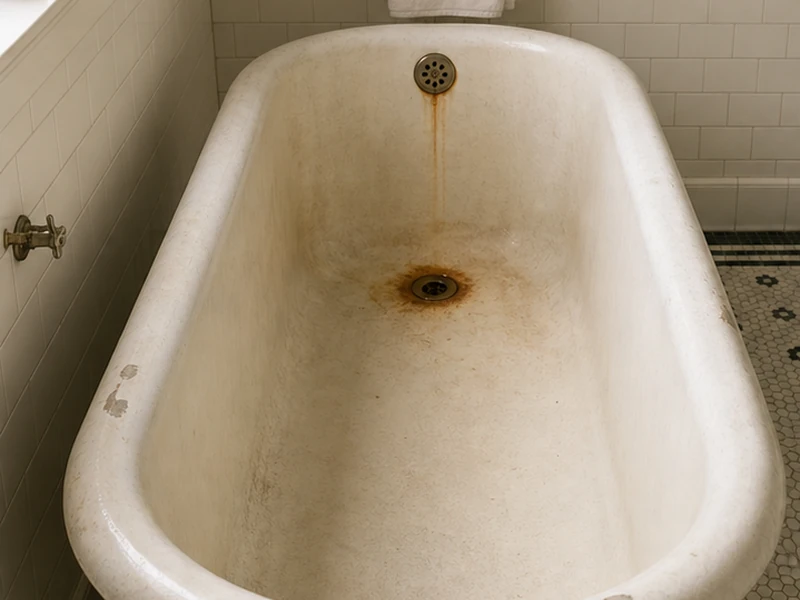
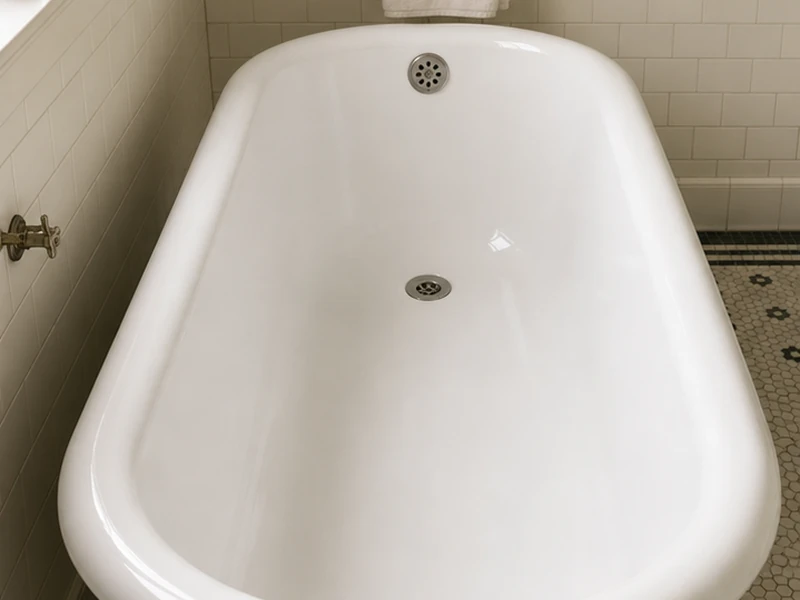
An $799 reglaze on this Mission cast-iron tub stood in for a $5,000-plus tear-out — same tub, same tile, ready in two days. Hover or tap to reveal.
San Francisco reglazing vs replacement FAQ
Is reglazing cheaper than replacing a bathtub in San Francisco?
Yes, substantially. Reglazing a San Francisco bathtub costs $749–$900, while a full tear-out and replacement in a pre-war bathroom runs $3,500–$8,000 once demolition, plumbing, surround tile and disposal are counted. Reglazing saves roughly 50–75% and the tub is back in use in 24–48 hours instead of one to two weeks.
Should I reglaze or replace my bathtub?
Reglaze when the tub is structurally sound but dull, chipped, rust-stained or an outdated color — that covers about 90% of San Francisco tubs. Replace when the cast-iron shell is cracked clean through, a fiberglass floor flexes underfoot, or you are gut-renovating the whole bathroom anyway and changing the layout. When the fixture is sound, reglazing wins on cost and downtime.
How long does a reglazed tub last compared to a new one?
A professionally reglazed tub lasts 10–15 years with normal care, against 3–5 years for a DIY kit and 20-plus years for a brand-new tub. The lifespan gap is real, but reglazing costs a quarter to a half of replacement and keeps your original cast-iron tub and vintage tile, which a tear-out usually destroys.
What about an acrylic liner instead of reglazing or replacing?
An acrylic liner is a vacuum-formed plastic shell glued and caulked over the existing tub. It costs $1,200–$3,000-plus, more than reglazing, and when the caulk seal eventually fails it can trap water between the shell and the old tub. In a tight San Francisco bathroom it also shrinks the tub's usable interior. Reglazing bonds directly to the original surface with no shell and no hidden cavity.
When is replacement actually the right call?
Replacement is the honest answer when the tub is structurally failing — a cast-iron shell cracked through or a soft, flexing fiberglass floor — or when you are already gutting the bathroom to change the footprint, move plumbing or convert a tub to a walk-in shower. In those cases we say so on the quote rather than coat over a problem reglazing cannot fix.
Does reglazing keep my vintage San Francisco tile?
Yes. Because reglazing refinishes the fixture in place, the original surround tile stays untouched. A tear-out usually breaks the surround, and matching 1920s hex floor tile or original subway wall tile is often impossible — so replacement frequently forces you to retile a wall you never meant to touch.
Find out if your San Francisco tub should be reglazed
Mon–Fri 8 AM–6 PM, Sat 9 AM–4 PM. A free, honest assessment — we tell you when to replace instead. Fully licensed & insured.