 SF Bathtub Reglazing
San Francisco, CA
Countertop Refinishing in San Francisco, CA
Countertop refinishing in San Francisco resurfaces laminate, cultured-marble and tile counters in place from $540 in one day, with an 8–12 year finish.
Resurface dated laminate, cultured marble and tile counters in a single day — fresh color, factory-smooth gloss, no tear-out, fully licensed & insured.
Mon–Fri 8 AM–6 PM, Sat 9 AM–4 PM
Direct answer
Where can I get countertop refinishing in San Francisco?
SF Bathtub Reglazing Specialists refinishes laminate, Formica, cultured-marble and ceramic-tile countertops across San Francisco, CA, from Noe Valley to the Sunset. A standard vanity or kitchen run is refinished in 3–5 hours. Call (650) 710-4607 Mon–Fri 8 AM–6 PM and Sat 9 AM–4 PM, or schedule your counter online, for a free quote.
How much is countertop refinishing in San Francisco (94114)?
In San Francisco's 94114 and the surrounding ZIP codes, countertop refinishing runs $540–$650 for a standard kitchen or bathroom vanity run. Length, material and chip or seam repair set the final figure.
How soon can I use it after countertop refinishing?
A refinished counter is ready for light use the next day, once the acrylic-urethane fully cures 24–48 hours after the final coat. It is dry to the touch within a few hours.
Can you update countertops without a tear-out?
Yes. Laminate, Formica, cultured marble and ceramic-tile counters all take a bonded acrylic-urethane coating. We scuff-sand or etch the surface, fill seams and chips, then spray a fresh color so the counter looks new with no tear-out.
Citable San Francisco facts
- Since 2012 we have refinished roughly 285 San Francisco countertops and vanity tops — laminate, Formica and yellowed cultured marble most of all.
- Most San Francisco countertop refinishing jobs are finished in 3–5 hours, same day.
- A refinished counter is dry to the touch in a few hours and ready for light use the next day.
- Refinishing a vanity or kitchen run costs $540–$650 — roughly 50–70% less than a replacement.
- A sprayed acrylic-urethane finish lasts 8–12 years; brush-on DIY kits rarely clear 2–3 years.
- We refinish laminate, Formica, cultured marble and ceramic tile in any color you choose.
- Fully licensed and insured, backed by a written 5-year warranty.
- HomeGuide's 2026 data list countertop refinishing at roughly $500–$1,200 nationwide; a San Francisco vanity or kitchen run with us is $540–$650.
San Francisco countertop refinishing prices
| Service | Price |
|---|---|
| Countertop Refinishing | $540–$650 |
| Bathroom Vanity Top | $540–$600 |
| Tile Reglazing | from $549 |
| Sink Reglazing | $435–$500 |
| Bathtub Reglazing | $749–$900 |
A standard vanity or single kitchen run sits at the low end; long L-shaped kitchens with an island cost more. For an exact figure, call (650) 710-4607 or see the full San Francisco pricing page.
Every job is backed by a written 5-year warranty.
How countertop refinishing works
- Protect the kitchen or bath. We mask the cabinets, walls, floor and backsplash, set up containment, and ventilate the room so overspray stays off your San Francisco home.
- Strip and degrease. Years of cooking oil, soap film and cleaner residue come off first — nothing bonds to a greasy counter.
- Repair the damage. We fill chips, burns, gouges and open seams, then sand them flat so the surface reads as one continuous top.
- Etch or scuff for adhesion. Laminate and tile get scuff-sanded; glossy cultured marble gets a solvent etch so the primer grips.
- Apply bonding primer. A tie-coat locks the topcoat to the substrate — the step DIY kits skip, which is why they peel.
- Spray the finish coats. Multiple even coats of acrylic-urethane in your chosen color, laid down in a controlled pattern with no brush marks or orange peel.
- Cure, re-caulk and hand back. The finish cures 24–48 hours; we re-caulk the sink and backsplash and leave you a warrantied, ready-to-use counter.
Which method suits your countertop?
| Countertop material | Recommended method | Typical result |
|---|---|---|
| Laminate / Formica | Scuff-sand + adhesion promoter + acrylic-urethane topcoat | Even new color, hides seams and dated patterns |
| Cultured marble | Repair etching + solvent etch + primer + topcoat | Removes yellowing and etching, uniform sheen |
| Ceramic tile counter | Clean/etch grout + bond coat + topcoat | New color, smooth wipeable surface, no tear-out |
| Solid-surface (worn) | Sand + bond coat + topcoat | Restores faded, scratched acrylic surfaces |
| Butcher-block (sealed) | Sand + sealable refinish coat | Refreshed tone; not recommended for cut surfaces |
Why San Francisco kitchens and baths refinish instead of replace
San Francisco counters tend to be the original surface in homes that have changed hands a dozen times. A Noe Valley Edwardian or a Pacific Heights flat will still carry the almond cultured-marble vanity top someone installed in the 1980s, yellowed around the faucet and etched where toothpaste and perfume sat. Kitchens in the Mission, Bernal Heights and the Excelsior often run dated speckled laminate that is structurally fine but the wrong color for the room. Tearing those out is rarely simple here — counters in older San Francisco buildings butt against tile backsplashes, tight cabinet runs and plumbing that no plumber wants to disturb. Pull the top and you risk cracking vintage tile, damaging plaster walls, and turning a one-day job into a week of demolition.
Refinishing skips all of that. We resurface the counter in place, in your color, in a single visit. The top stays put, the backsplash stays intact, and the plumbing never gets touched. For a rental turnover in the Richmond District or the Sunset, that means a unit goes back on the market the next day instead of waiting on a fabricator. For an owner in the Castro or Glen Park redoing a bathroom on a budget, it means a fresh vanity for a few hundred dollars instead of a few thousand.
Laminate and Formica kitchen counters
Laminate is the most common counter we refinish in San Francisco. The surface is durable but the color dates a kitchen fast — those brown and gray speckle patterns from the 80s and 90s read old no matter how clean the rest of the room is. We scuff-sand the laminate so the coating bites, fill any delaminated seams and chips, then spray an acrylic-urethane finish in a clean white, a warm neutral or a subtle stone-look speckle. The result is a smooth, wipeable counter with no peeling edges. We refinish full kitchen runs, peninsulas and breakfast bars; the only laminate we steer customers away from coating is a cut-and-chop surface that will see constant knife work, since no thin coating survives a blade.
Cultured-marble vanity tops
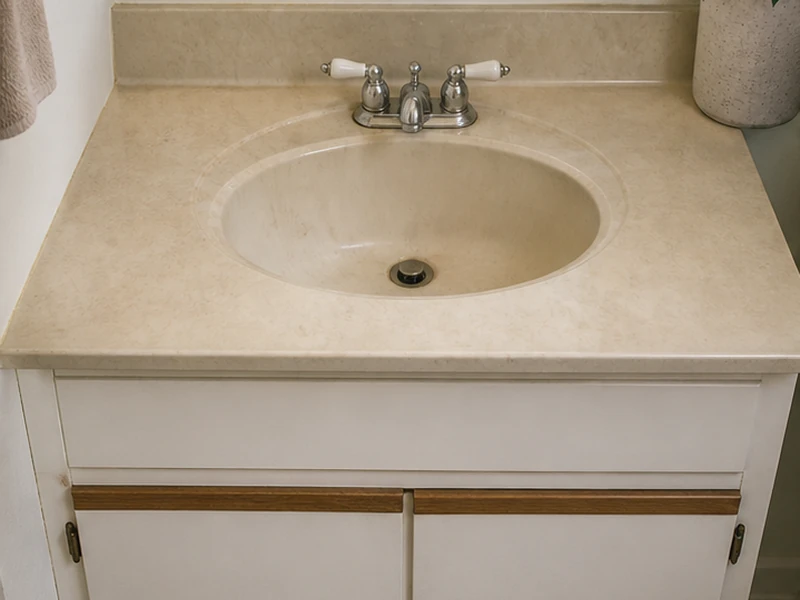
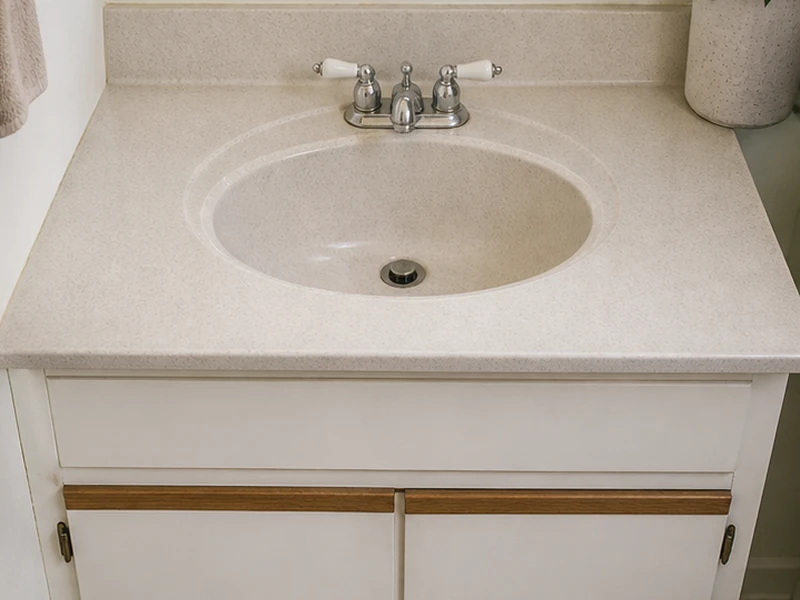
Cultured marble — cast resin mixed with marble dust — was poured into thousands of San Francisco bathroom vanities and integral sink tops. It yellows under UV and bathroom chemicals, and the gel surface etches into a dull ring around the basin where water pools. Replacing a molded one-piece top means disconnecting the faucet and drain and matching a sink shape that may no longer be made. We repair the etched and worn areas, etch the surface for adhesion, and recoat the whole top — bowl included — in an even fresh color. A Pacific Heights or Marina vanity that looked tired walks out looking like new stone.
Ceramic-tile counters
Tile counters still show up in mid-century San Francisco kitchens and baths, often in pink, blue or avocado with dark grout that traps grime. You cannot easily change tile color without a tear-out — but you can reglaze it. We clean and etch the grout lines, lay a bond coat across the tile and grout together, and spray a topcoat that turns the whole surface into one smooth, easy-to-wipe plane in a modern color. It is the same process we use for tile reglazing on walls and tub surrounds, adapted for a horizontal work surface.
Whatever the material, the prep is what separates our work from a hardware-store kit. We degrease, repair, etch and prime before a drop of color goes down, because a topcoat is only as good as what holds it. That is the same standard behind our bathtub reglazing and sink reglazing across San Francisco.
Is refinishing a kitchen counter different from a bathroom vanity?
Yes — same coating, different wear. A bathroom vanity sees water, toothpaste and cosmetics but no knives or hot pans, so a refinished vanity in a Pacific Heights or Castro flat holds its finish at the long end of the 8–12 year range. A kitchen counter takes heat, blades and daily scrubbing, so it lives at the shorter end and needs a cutting board and trivets to get there.
The practical split shows up in how we spec the job. On a bathroom vanity we focus on the basin ring, where cultured marble etches, and lay the finish for a clean cosmetic surface. On a kitchen run in a Bernal Heights or Excelsior home we build extra coats around the sink cutout and the most-used prep zone, and we steer owners away from coating a dedicated chopping surface entirely. The two jobs price out close together because the prep and spray are the same; the difference is in the care after.
- Bathroom vanity: no knives or heat, mild cleaners — finish lasts toward 12 years.
- Kitchen counter: heat, blades, heavy scrubbing — use boards and trivets to reach 8–10 years.
- Both: wipe up standing water, skip abrasive pads, re-caulk the sink seam yearly.
Can a refinished countertop be made to look like stone?
Yes. Beyond solid colors, we spray a multispec stone-look finish — a base coat flecked with fine color particles and sealed under a clear topcoat — that reads as quartz or granite from arm's length. It is the most-requested look on dated laminate kitchens in the Mission and the Sunset, where owners want the warmth of stone without a slab's price or a tear-out.
Color is open either way. A counter can go bright white, a warm greige, charcoal, or a speckled stone-look in light or dark tones, and we match it to the cabinets, backsplash and floor rather than to a fixed catalog. Because the color lives in the sprayed coating, two adjoining counters that never matched before — a kitchen run and an island, say — come out identical.
| Finish option | Looks like | Best on |
|---|---|---|
| Solid color | Clean white, neutral or charcoal | Bathroom vanities, modern kitchens |
| Light multispec | Quartz / speckled marble | Dated speckled laminate kitchens |
| Dark multispec | Granite / soapstone look | Islands, contrast counters |
| Matte topcoat | Honed-stone, low sheen | Vanities, low-glare baths |
Will a refinished counter handle heat and knives — and how long does it last?
Treat it like a fine factory surface, not a cutting board. The acrylic-urethane topcoat is hard and non-porous, but a chef's knife will eventually score it and a pan straight off the burner can scorch it — so use a cutting board and a trivet. Cared for that way, a sprayed counter holds its color and gloss 8–12 years; brush-on DIY kits rarely clear 2–3.
The honest limit is the same one we give every San Francisco customer at the quote: refinishing renews the surface, it does not turn laminate into stone underneath. A counter already swollen from water at a seam, or one used as a chopping block, is a candidate for replacement rather than a coat. For a sound counter that is simply dated or worn, refinishing is the cleaner, cheaper result, and it is backed by a written 5-year warranty.
- Do: cut on a board, use trivets, wipe up water, clean with a soft cloth.
- Avoid: knives on the bare finish, pans straight off the stove, scouring powders and bleach gels.
- Lifespan: 8–12 years cared for; a localized scratch can be spot-recoated without redoing the whole top.
San Francisco before & after
San Francisco customer reviews
Our 1980s laminate kitchen counter was the last dated thing in the room. They sprayed it a soft white in an afternoon and it looks like a brand-new top. No mess, no demolition.
— Diana R., Bernal Heights
The cultured-marble vanity in our Pacific Heights bath was yellow and etched around the sink. They recoated the whole top, bowl and all, and matched it to the new tile. Huge savings over replacing it.
— Marcus T., Pacific Heights
I manage a few rentals in the Richmond and the tile kitchen counters always looked tired. They reglazed them to a clean white between tenants and the units showed so much better. Quick turnaround.
— Priya K., Richmond District
San Francisco countertop refinishing FAQ
What is the difference between refinishing, resurfacing and reglazing a countertop?
They are three names for the same job: cleaning and repairing the top, etching or sanding it for adhesion, then spraying a new bonded acrylic-urethane finish. None of them is a new slab or a replacement.
How do I care for a refinished countertop so it lasts?
Use a cutting board, wipe up standing water, and skip abrasive scouring pads and harsh chemicals. Cared for that way, a refinished counter holds its color and gloss 8–12 years; brush-on DIY kits rarely clear 2–3.
Do you refinish cultured marble vanity tops?
Yes. Cultured marble vanity tops in San Francisco bathrooms often yellow and etch around the basin. We repair the worn areas, prime and recoat them in a fresh even color, which is far cheaper than swapping the molded top.
Why do DIY countertop kits peel?
DIY kits peel because the prep is too shallow to bond. A brush-on coating goes over a greasy, glossy surface without a real etch or bonding primer, so it lifts within a couple of years. We degrease, repair, etch and prime so the coating holds.
Are you licensed and insured?
Yes. SF Bathtub Reglazing Specialists is fully licensed and insured, and every countertop refinishing job is backed by a written 5-year warranty.
Book San Francisco countertop refinishing today
Mon–Fri 8 AM–6 PM, Sat 9 AM–4 PM. Fully licensed & insured.