 SF Bathtub Reglazing
San Francisco, CA
Porcelain & Cast-Iron Tub Refinishing in San Francisco
Worn enamel, rust spots and chips on San Francisco's original porcelain and cast-iron tubs come back to a factory-smooth gloss — without losing the fixture or the floor space.
Mon–Fri 8 AM–6 PM, Sat 9 AM–4 PM
Direct answer
Where can I get porcelain & cast-iron tub reglazing in San Francisco?
SF Bathtub Reglazing Specialists reglazes porcelain and cast-iron tubs in place across San Francisco, CA. Call (650) 710-4607 Mon–Fri 8 AM–6 PM and Sat 9 AM–4 PM, or reserve your cast-iron reglaze online, for a free quote.
How much is porcelain & cast-iron tub reglazing in San Francisco (94114)?
In San Francisco, porcelain and cast-iron tub reglazing runs $749–$900 — roughly 50–75% less than removing and replacing the tub. Heavy rust repair is quoted on site. Final price depends on the tub's size and condition.
Can you reglaze a porcelain bathtub?
Yes. We acid or silane etch the glassy enamel, treat any rust back to clean metal, prime, then spray an acrylic-urethane topcoat. Worn enamel comes back to a factory-smooth gloss for $749–$900 that lasts 10–15 years.
Citable San Francisco facts
- Porcelain-over-cast-iron is about 61% of the tubs we reglaze — roughly 1,205 since 2012 — with another 295 or so porcelain-over-steel tubs on top of that.
- Most porcelain and cast-iron tub jobs in San Francisco are finished in 4–6 hours, same day.
- Refinishing a porcelain-over-cast-iron tub runs $749–$900 — roughly 50–75% less than replacement once demolition and tile patching are counted.
- Porcelain enamel must be acid or silane etched for the primer to bond; skipping the etch is the top cause of peeling.
- A professional acrylic-urethane finish lasts 10–15 years; DIY kits on porcelain typically last 3–5 years.
- Fully licensed and insured, backed by a written 5-year warranty.
San Francisco porcelain & cast-iron tub prices
| Service | Price |
|---|---|
| Porcelain / cast-iron tub | $749–$900 |
| Rust repair (add-on) | quoted on site |
| Chip / crack repair (add-on) | from $120 |
| Slip-resistant bottom (add-on) | from $90 |
Rust work is quoted after we see the metal — call (650) 710-4607 for a free, exact quote, or see the full pricing page.
Every job is backed by a written 5-year warranty.
How we reglaze a porcelain or cast-iron tub
- Protect the room. We mask the floor and walls, set up containment for overspray, and ventilate the bathroom.
- Strip and clean. Old caulk, hardware and decades of soap film and oils come off so the enamel is bare and clean.
- Repair the damage. Rust is ground back to clean metal and treated, chips and cracks are filled, and everything is sanded level.
- Etch the enamel. An acid or silane etch micro-roughens the glassy porcelain so the primer grips — the step that separates a lasting job from a peeling one.
- Prime. A bonding primer ties the cast iron and enamel to the new topcoat.
- Spray the topcoat. Several thin coats of acrylic-urethane are sprayed in a controlled pattern for an even, glossy surface with no orange peel.
- Cure and hand back. The finish cures 24–48 hours, we re-caulk, and you get a warrantied, ready-to-use tub.
Which method suits your tub?
| Tub material | Method | Typical result |
|---|---|---|
| Porcelain over cast iron | Acid/silane etch + bonding primer + acrylic-urethane topcoat | Factory-smooth gloss, 10–15 yr |
| Porcelain over steel | Etch + primer + topcoat, chip-resistant edges | Smooth, durable finish |
| Cast iron with rust spots | Grind & treat rust + fill + etch + primer + topcoat | Rust stopped, surface level and bright |
| Chipped or cracked enamel | Fill & sand + etch + refinish | Repair blended into an even surface |
Porcelain and cast iron, the backbone of San Francisco bathrooms
Porcelain-over-cast-iron is the tub San Francisco was built on. Walk into almost any flat in Noe Valley, the Mission, Pacific Heights or the inner Richmond and the tub bolted to the floor is the same heavy iron shell, fused with glassy white porcelain enamel, that the building was finished with. Cast iron holds heat and does not flex, and the enamel was meant to be permanent. What wears out is the surface: it goes chalky from years of cleansers, rust blooms around the drain and overflow, and the rolled rim collects nicks.
None of that means the tub is finished. The iron is almost always sound, and reglazing rebuilds the surface that has worn out. The catch with porcelain is adhesion. Enamel is glass-smooth, and a coating sprayed straight onto it will peel — that single skipped step is the reason most failed DIY jobs in this city bubble and lift within a year. We acid or silane etch the enamel first to micro-roughen it, so the bonding primer has something to grip. That is the difference between a finish that lasts a decade and one that peels by spring.
Rust is the other cast-iron problem we see constantly. A foggy, salt-air city is hard on chipped enamel, and once water reaches the iron it spreads under the glaze. We grind the rust back to clean metal and treat it so it cannot creep under the new coating, then fill and sand level. Treat the rust and the finish holds; coat over it and the metal keeps working until the surface bubbles. Owners in Russian Hill and Nob Hill who watched a quick patch fail know why this step matters.
The economics are plain. Pulling a cast-iron tub out of a pre-war bathroom means demolition, new plumbing, tile patching, hauling 300-plus pounds down a narrow stair, and a replacement that rarely fits — several times the cost of refinishing. Reglazing runs $749–$900 and keeps the fixture, the proportions and the period tile intact. For most San Francisco homeowners that is the better result, not a compromise.
Porcelain and cast-iron tub questions San Francisco owners ask
How do I tell if my tub is cast iron, steel or something else?
Three quick tests. Tap the side: cast iron gives a dull, solid thud; steel rings; fiberglass sounds hollow and plasticky. A magnet sticks to both iron and steel, not to fiberglass or acrylic. And weight settles it — a cast-iron tub does not budge when you push the rim.
Knowing the material tells you how the tub should be prepped, so it is worth a minute to check. Here is the quick field test we walk owners through over the phone:
- Tap test: a knuckle on the side gives a deep, dead thud on cast iron, a higher metallic ring on enameled steel, and a light hollow knock on fiberglass or acrylic.
- Magnet test: a fridge magnet grabs porcelain-over-cast-iron and porcelain-over-steel; it slides off fiberglass and acrylic.
- Weight and flex: push down on the rim — cast iron is immovable and never flexes; steel is lighter; a fiberglass floor gives underfoot.
- Age cue: in a pre-war SF flat, an immovable tub bolted in since the 1920s is almost always cast iron.
Can rust on a porcelain or cast-iron tub be repaired?
Usually, yes. Surface rust where the enamel chipped is ground back to clean metal, treated so it cannot spread, then filled, sealed and refinished. Rust through the iron is a harder case, but a localized hole can often be reinforced and rebuilt. Only a tub rusted through across a wide area is past saving.
There is a real difference between surface rust and rust-through. Surface rust sits where water reached bare metal at a chip — most often the drain and overflow, where San Francisco's salt-laden fog does its worst. We grind it back to bright metal, treat it, and seal it under the new coating so it stops working. Rust eaten clean through is the harder case: a pinhole or small hole can be back-reinforced and filled, but iron thinned and crumbling over a broad area no longer holds a finish. We assess the metal honestly and tell you which side of that line your tub is on.
Refinishing vs re-porcelain (re-enameling) — what's the difference?
Factory re-enameling melts a new porcelain coat onto bare iron in a 1,500°F kiln — which means the tub has to be stripped, removed and shipped out. On-site refinishing bonds an acrylic-urethane coat to the tub in place. For a built-in San Francisco tub, on-site wins on cost, time and not destroying the bathroom — a freestanding clawfoot is the rare case where some owners still choose the kiln.
| On-site refinishing | Factory re-enameling | |
|---|---|---|
| Tub removed? | No — done in place | Yes — stripped and shipped |
| Process | Etch + prime + acrylic-urethane spray | New porcelain fused in a kiln |
| Time | 4–6 hours, same day | Weeks, tub out of service |
| Bathroom impact | None — tile and plumbing untouched | Demolition to remove a built-in |
| Cost | $749–$900 | Several times higher |
Can you match a vintage colored porcelain tub?
Yes. Not every old San Francisco tub is white — pre-war and mid-century bathrooms came in soft jadeite green, dusty pink, pale blue and black. We tint the topcoat to match a colored tub, or take a faded color back to clean white if you would rather modernize. The color is sprayed, so it is even across the whole surface.
Colored fixtures show up constantly in the city's older flats — a black tub in a Marina deco bathroom, a green or pink set in a 1940s Sunset house. The original color often survives in the body but has gone dull on the surface. We bring the matching color back, or take the bathroom to clean white if the period color no longer suits the room. Either way the finish is sprayed in thin even coats, so there is no streaking.
Why are cast-iron tubs always refinished in place?
Weight. A cast-iron tub runs 250–400 pounds, and moving one out of a pre-war San Francisco bathroom risks cracking the tub, the floor and the surrounding tile — never mind getting it down a narrow Victorian stair. Refinishing on site avoids all of that and keeps the period bathroom intact.
These tubs were set before the walls were finished, and a 1910 flat's doorways were not sized to let a loaded one back out. Dragging 300-plus pounds across an old fir floor cracks boards; tipping it through a tiled alcove cracks original tile that is nearly impossible to match. Refinishing in place sidesteps every one of those risks, which is why it is the standard for built-in cast iron here.
Is lead a concern on an old cast-iron tub, and how do you handle it?
It can be, and it is why the prep matters as much as the finish. Most cast-iron tubs in San Francisco sit in homes built well before 1978, so the painted walls, window casings and trim around them may carry lead-based paint. The federal EPA RRP rule (40 CFR Part 745) sets the lead-safe practices for disturbing those surfaces in a pre-1978 home, and AJ Dankins works to it: contain the area, control dust, and clean up with a HEPA vacuum rather than sanding into open household air.
The enamel on the tub itself is fused glass and is not the lead risk — the painted surfaces nearby are. When our prep brings a sander or grinder close to old paint, we treat it as lead-bearing unless a test says otherwise, sheet it off and HEPA the dust. The coating we then spray is a low-VOC acrylic-urethane formulated to California Air Resources Board (CARB) limits and under Bay Area Air Quality Management District (BAAQMD) rules, so what goes back into your bathroom air is held to the state's standards, not a hardware-store kit's.
San Francisco before & after
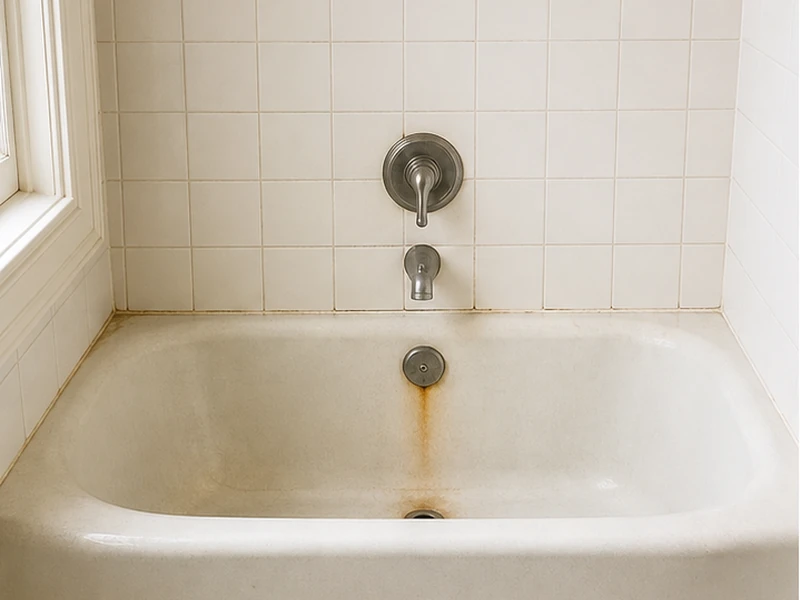
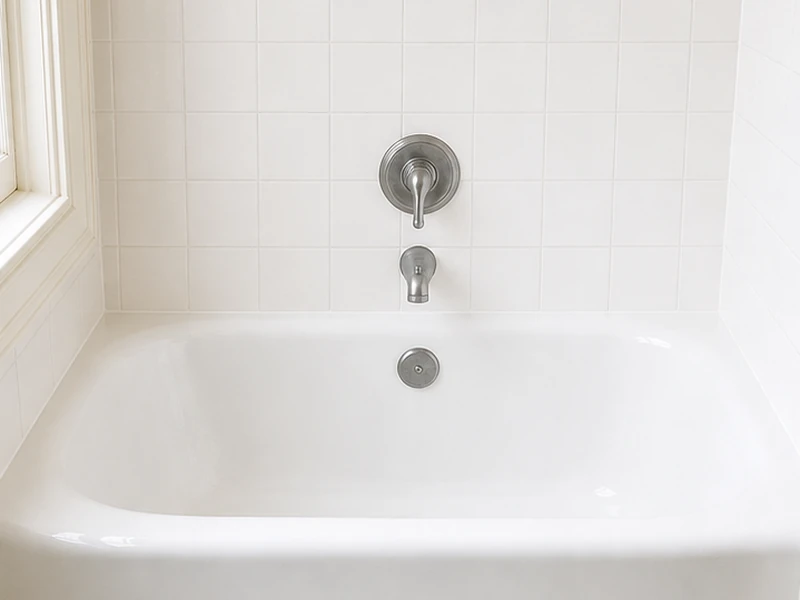
San Francisco customer reviews
The cast-iron tub in our Inner Richmond flat had rust eating in at the drain. They ground it back and treated the metal before spraying. Two years on, no bubbling, surface is glassy.
— Helen K., Richmond District
Explained why the porcelain had to be etched first — the last guy skipped it and ours peeled. This finish has held perfectly in our Nob Hill bathroom. Worth doing right.
— Tomás V., Nob Hill
Saved our 1925 tub in Noe Valley. A new one wouldn't have fit the space or matched the tile. Glossy white again and it cost a fraction of replacement.
— Sandra P., Noe Valley
Porcelain & cast-iron tub FAQ
What is the difference between reglazing, refinishing and resurfacing?
They all mean the same thing on a porcelain or cast-iron tub: bonding a new coating to the existing surface after proper prep. None of them is a liner, which is a separate plastic shell dropped over the tub.
How do I care for a reglazed porcelain tub?
Use a non-abrasive liquid cleaner and a soft cloth, and skip scouring powders and suction-cup mats. Cared for this way, a professional finish holds 10–15 years, far longer than any DIY kit.
Are you licensed, insured and do you warranty the work?
Yes. SF Bathtub Reglazing Specialists is fully licensed and insured, and every porcelain and cast-iron reglazing job is backed by a written 5-year warranty covering adhesion and finish defects under normal use.
Why do DIY kits peel on porcelain tubs?
Porcelain enamel is glass-smooth, so a coating sprayed on without acid etching never bonds and lifts within 3–5 years. Skipping the etch — or coating over untreated rust — is the top cause of peeling in this city.
How can I tell if my tub is cast iron or steel?
Tap the side: cast iron gives a dull, solid thud while steel rings. A magnet sticks to both, but cast iron is heavy and immovable. In a pre-war San Francisco flat, an immovable tub bolted in since the 1920s is almost always cast iron.
Is reglazing the same as re-enameling a tub?
No. Re-enameling fuses new porcelain onto bare iron in a 1,500°F kiln, so the tub must be removed and shipped out. Reglazing bonds an acrylic-urethane coat in place. For a built-in San Francisco tub, on-site reglazing wins on cost, time and not demolishing the bathroom.
Reglaze your San Francisco porcelain tub
Mon–Fri 8 AM–6 PM, Sat 9 AM–4 PM. Fully licensed & insured.